A big red sleigh laden with gifts won’t be the only unusual object flying at extreme speed through the sky this Christmas. No, for physicists and space-enthusiasts the world over, the Ariane 5 rocket blasting off from French Guiana carrying the James Webb Space Telescope will be the greatest Christmas gift of all.
The much-anticipated launch has been delayed seven times over the last three years due to technical issues with the telescope, the launch vehicle and launch site, as well as delays caused by COVID-19. But it seems that, as long as weather conditions remain stable, the largest-ever space observatory will finally begin its 10-year mission at 12:20 GMT on Christmas Day, 2021.
The Webb telescope’s month-long journey to its final destination – a special point in space one million miles beyond Earth known as L2 – is peanuts compared to its 25-year development. And at a cost of around $10 billion, Webb is one of the most expensive objects ever built.
What is all the fuss about? Why invest so much time and money into this project? Well, NASA and collaborating partners hope Webb will answer some of the most fundamental questions about the universe. From the very first stars and galaxies in the universe, to exoplanets, comets and baby stars, Webb will use its massive 6.5-metre-diameter mirror to observe the formations of many key astronomical bodies. Webb will tell us how the first stars illuminated the dark primordial cosmic web, and how large-scale structure evolved over the last 13.7 billion years. We will also observe star- and planet-forming regions in our local corner of space, as well as comets and asteroids in our own solar system, to test our theories of how planets like Earth came to be. Webb will analyse the atmospheres of extra-solar planets in a search for the signatures of life, and could help solve the puzzle of Dark Matter by observing the distortion of light from very distant galaxies.
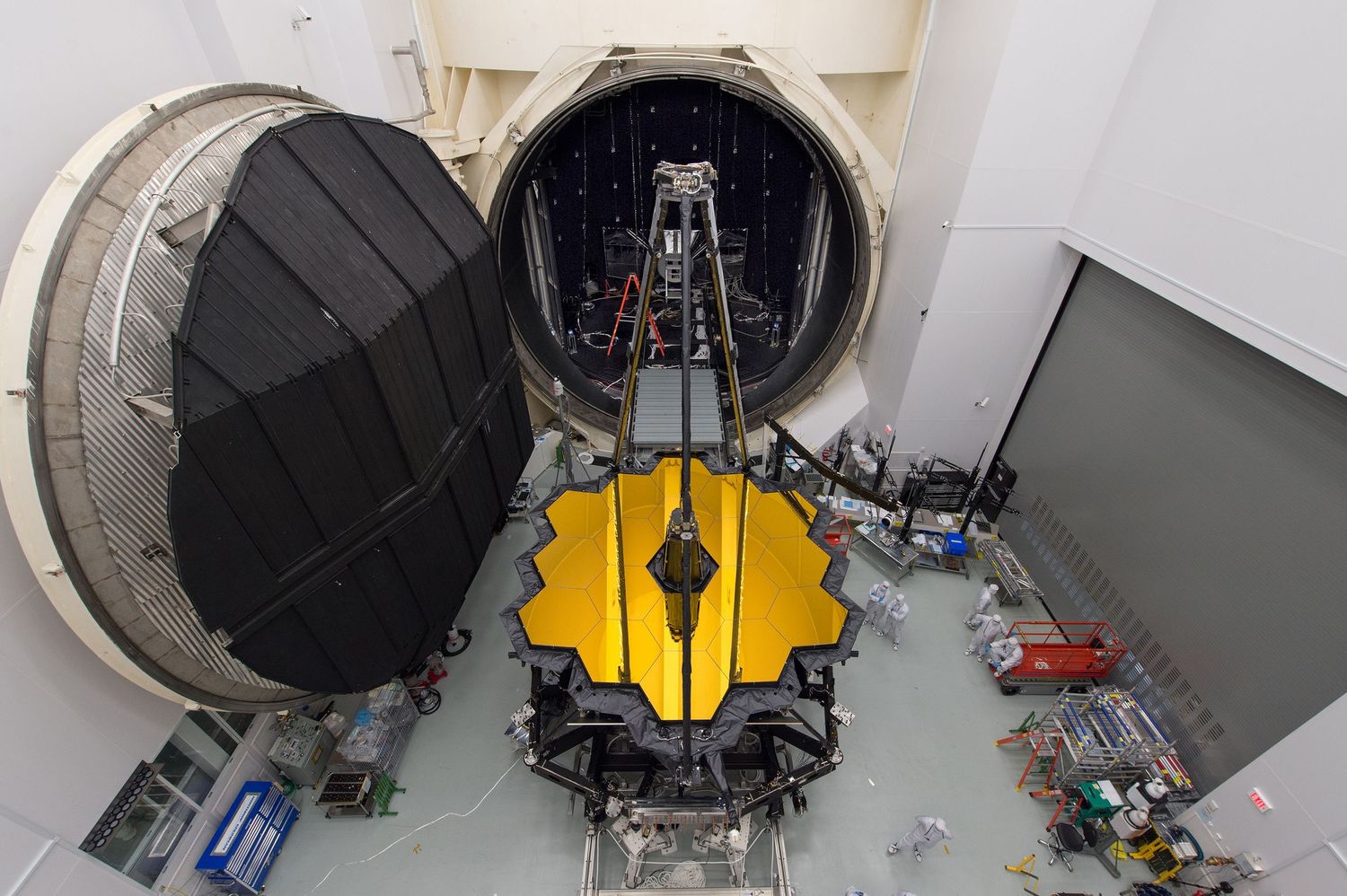
James Webb Space Telescope entering NASA’s enormous Space Power Facility vacuum chamber for testing.
The first of these objectives – observing the first stars in the universe – is Webb’s raison d’etre. Only 100 million years after the Big Bang, when the universe was about 1% its current age, clouds of newly-formed hydrogen and helium gas cooled sufficiently to clump into dense spherical bodies, before igniting into the first stars. They burned hot and bright, fusing atoms in their cores and creating heavier elements. And when their fuel was exhausted, they collapsed and exploded, spreading their constituent matter far and wide through the universe. These stars emitted intense ultra-violet radiation, and their starlight continued to travel long after they had expired.
This is the light that Webb is designed to detect. In the present epoch, however, the light reaches us as infrared radiation, its wavelength having been stretched over the last 13.7 billion years by the expansion of the universe. And that is why Webb needs to travel so far from home: our atmosphere is full of infrared radiation. The warmth you feel from the Sun is infrared, as is the energy emitted by the sky and the ground, and all this background noise makes searching for faint starlight impossible on Earth. Only by travelling far beyond any sources of pollution can Webb begin its observations.
The other issue is that the longer the wavelength of light, the more “fuzzy” it appears on an image sensor. It becomes more and more difficult to take sharp pictures as you move from optical light into the infrared, and that’s the reason for Webb’s enormous 6.5 metre mirror. With a collecting area 6.25x larger than the Hubble telescope, Webb will scoop up as many particles of light as possible for the maximum possible clarity.
But in space travel, every kilogram of payload weight adds tens of thousands of dollars to the launch cost, and launching such a big telescope would be prohibitively expensive using traditional glass mirrors. Luckily, material sciences have come a long way since the Hubble era, and Webb has been designed with cutting-edge weight-saving technology throughout. Comprised of 18 smaller hexagonal mirrors, the primary mirror is built from beryllium, a super-lightweight and stiff metal, coated in a 100 nanometre-thick layer of gold. This coating was chosen because of gold’s fantastic ability to reflect infrared radiation, as well as its resistance to tarnishing, and in total only 48.2 grams of gold cover an area the size of a tennis court service box. In all, the Webb mirror is 62% lighter than Hubble’s, despite being six times the size.
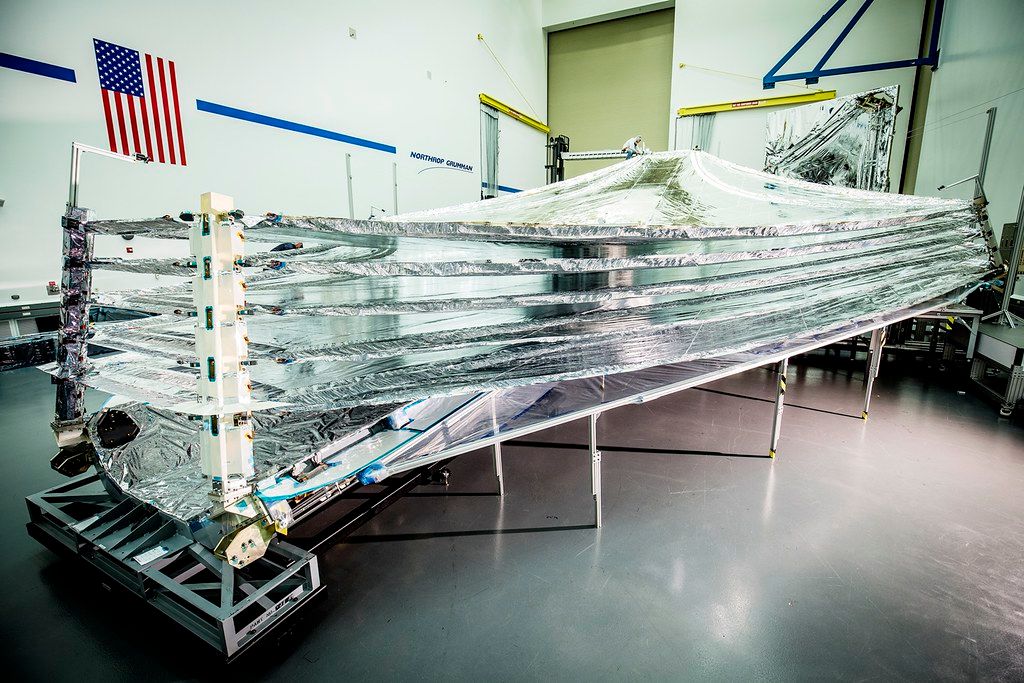
JWST’s unique sunshield will protect the telescope from the Sun’s warming rays, keeping the instruments at a frosty -233*C.
Sticking with the theme, perhaps the most impressive element of this observatory is the tennis court-sized sunshield, designed to sustain a temperature gradient of 316°C (+83°C on the sun-facing side, -233°C on the dark side). As previously mentioned, sunlight is packed full of warming infrared radiation that could ruin any sensitive observations, so NASA engineers were forced to devise a system to protect the telescope from unwanted heat. Their solution is a testament to modern engineering – a 5-layer diamond-shaped sunshield made from Kapton, a “super-material” that is light, strong, resistant to degradation and stable across a range of temperatures, reducing the incident solar energy from 200,000 Watts to just 1 Watt. What makes it even more impressive is that the Kapton layers are only 0.025 millimetres thick. Each layer of the sunshield is also coated in a 100 nanometre-thick layer of aluminium to reflect as much light as possible, and the sheets are angled relative to each other to funnel any re-emitted radiation out into space.
To fit a tennis-court sized sunshield in a rocket fairing, though, NASA engineers need to carefully fold the fabric and deploy it once in space using an exceedingly complex unfolding mechanism. The deployment sequence has over three hundred individual points of failure, creating a real risk that this $10 billion project could fall over at the first hurdle.
“It’s almost like a parachute – you know that the parachute will work, but it’s also only as good as the very last time you fold it, and you’re going to find out whether you folded it correctly when you use it,” says Mike Menzel, Mission Systems Engineer for the James Webb project. To minimise the risk of failure, the sunshield will unravel very slowly over the course of three days, and special rip-stop seams have been woven into the fabric to prevent catastrophic tearing in the event of being struck by micrometeorites or space debris.
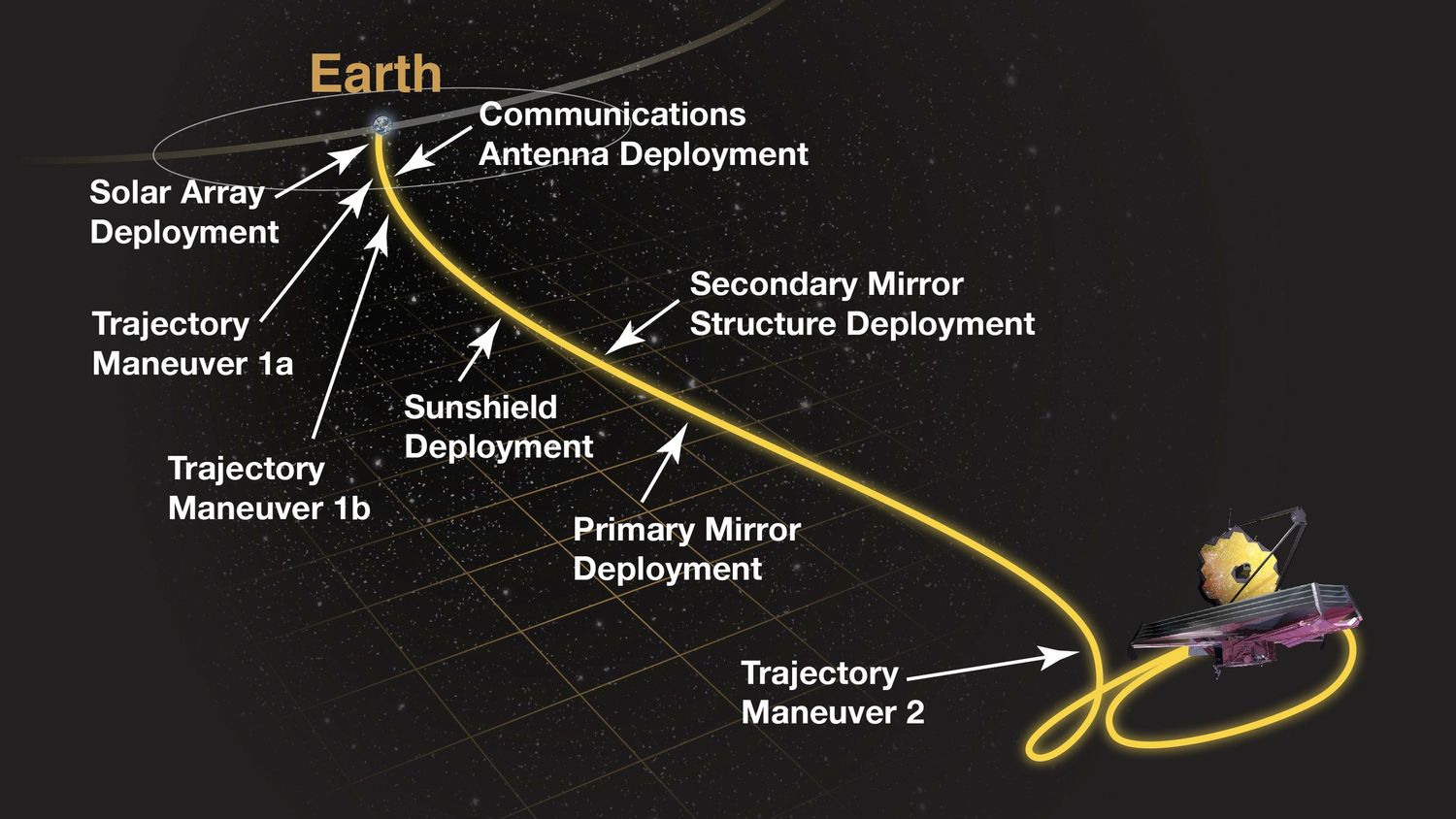
It will take Webb approximately a month to reach its final destination.
It will take Webb roughly a month to cover the 1 million miles to its destination, a gravitationally anomalous spot known as Lagrange Point 2, or L2 for short. The Sun-Earth system has five Lagrange points, co-discovered by Leonhard Euler and Joseph-Louis Lagrange in the 1760s, where the net gravitational force from the Sun and Earth perfectly balance out the centrifugal force a satellite would experience from orbiting at that point. In practice, this means that Lagrange points are gravitationally stable, and it requires only a very small amount of energy to stay there once you arrive.
The benefit of positioning Webb at L2 – the Lagrange point located on the opposite side of Earth from the Sun, is that there will be very little light pollution. The problem, however, is that NASA won’t be able to service the observatory. The Hubble telescope has been serviced five times in its life, allowing it to stay operational for over 31 years. Webb, on the other hand, has only a 10-year supply of fuel used for manoeuvring and orbit corrections, and once the fuel is spent, humanity’s most ambitious astronomy project will be useless.
This article can only scratch the surface of the enormous complexity of the Webb telescope, a true marvel of modern engineering. The fruits of labour of an entire generation of scientists will be a glorious machine capable of observing objects ten billion times as faint as the faintest stars visible to the naked eye, or twenty times dimmer than looking at a bedside lamp on the Moon. With any luck, it will provide answers to some of humanity’s most pressing questions – how did we get here, where are we going, and are we alone?
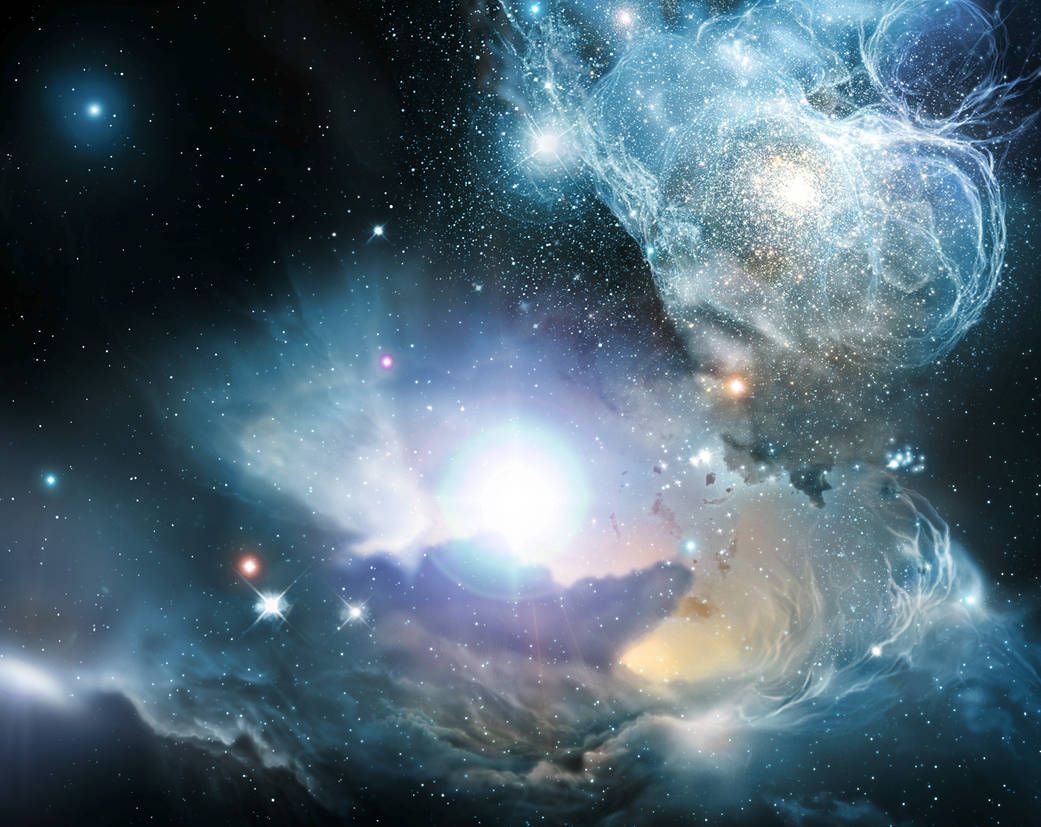
An artist’s impression of one of the Universe’s first quasars, a super-bright galaxy formed many billions of years ago.
